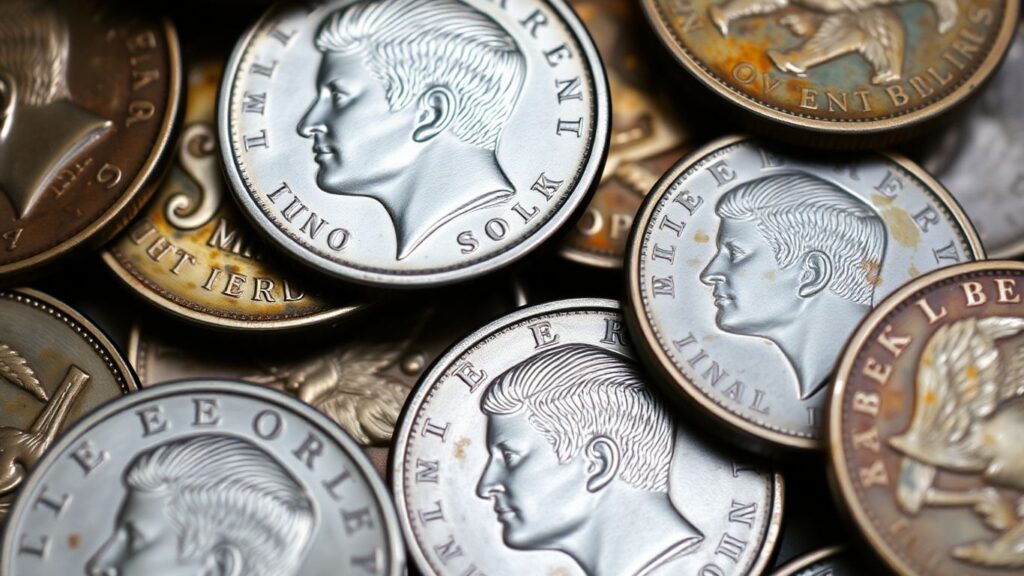
Lots of us have a jar of change somewhere, right? Maybe it’s in the kitchen, or maybe it’s just collecting dust in a drawer. You probably have a few Kennedy half dollars in there. Most of them are just worth 50 cents, maybe a little more if you’re lucky. But did you know some of these coins can be worth a whole lot more, even hundreds or thousands of dollars? It’s true. Why some Kennedy half dollars are worth more than face value isn’t always obvious, but it usually comes down to a few key things. Let’s break it down.
Key Takeaways
- The condition of a Kennedy half dollar is a big deal. Coins that look like they just came from the mint, with no wear and nice shine, are worth way more than ones that have been passed around a lot.
- Where the coin was made matters. The mint mark (or lack of one) tells you if it came from Philadelphia, Denver, or San Francisco, and this can really change its value.
- Sometimes, coins have mistakes from the minting process, like double images or being struck off-center. These errors can make a common coin suddenly quite rare and valuable to collectors.
- Proof coins, especially those with a special ‘Deep Cameo’ finish, are made for collectors and are often worth much more than regular coins, particularly if they are in top condition.
- While most 1974 Kennedy half dollars are common, finding one in extremely high grades, like MS68, makes it very rare and can lead to prices in the thousands of dollars at auction.
Understanding Why Some Kennedy Half Dollars Are Worth More
So, you’ve got a handful of Kennedy half dollars, and you’re wondering if any of them are worth more than just, well, fifty cents. It’s a fair question! Not all coins are created equal, and a few key things make some Kennedys stand out from the crowd.
The Role of Condition and Preservation
Think of it like this: a brand-new car is worth more than one that’s been driven through mud puddles for years, right? Coins are similar. The better a coin has been kept, the more it’s generally worth. We’re talking about things like:
- Luster: This is the original shine the coin had when it left the mint. If it’s still bright and flashy, that’s a good sign.
- Wear: Look closely. Are the details sharp, or are they worn smooth? Coins with sharp details, especially on Kennedy’s hair and the eagle’s feathers, are more desirable.
- Damage: Scratches, nicks, or bent coins? These all bring the value down.
The condition is often the biggest factor in a coin’s value. Even a common date can be worth a decent amount if it’s in absolutely pristine, uncirculated condition.
Collectors often talk about
The 1974 Kennedy Half Dollar: A Case Study in Value
The 1974 Kennedy half dollar might seem like just another coin in your pocket, but for collectors, it tells a story about how condition can really change things. Even though the Philadelphia Mint churned out a ton of these back in the day, finding one in really good shape is where the magic happens. Most of the ones you’ll find just hanging around are worth their face value, no big deal. But once you start looking at uncirculated coins, especially those graded MS66 and higher, their rarity jumps up quite a bit.
Conditional Rarity of the 1974 No Mint Mark
This coin is a prime example of what we call "conditional rarity." It means the coin isn’t rare because not many were made, but because very few have survived in top-notch condition. The Philadelphia Mint produced millions of 1974 half dollars, so you can find them easily if you’re just starting out. However, the real challenge, and the real value, comes when you find one that looks like it just left the mint. The jump in value from a circulated coin to a mint-state one is pretty significant, and it keeps going up as the grade gets higher.
- Circulated Coins: Generally worth face value ($0.50).
- Lower Mint State (MS60-MS65): Modest premiums, often a few dollars.
- Higher Mint State (MS66+): Value starts to climb noticeably.
- Exceptional Grades (MS68+): Become very scarce and command substantial prices.
The story of the 1974 no-mint-mark half dollar highlights how the passage of time and the rigors of circulation can transform a common coin into a sought-after rarity, purely based on its state of preservation.
The Appeal of High-Grade 1974 Specimens
What makes a high-grade 1974 half dollar so appealing? It’s all about the details. Collectors look for sharp details on President Kennedy’s portrait, especially on his cheekbone, and the crispness of the eagle on the reverse. Luster, that frosty or cartwheel effect you see on uncirculated coins, is also a big factor. A coin that still has its original mint luster and shows no signs of wear is what collectors are really after. These coins are not just metal; they’re tiny pieces of history preserved in near-perfect condition. Finding a 1974 half dollar in MS-65 and MS-66 condition can be worth between $60 and $75, showing a clear step up from lower grades.
Auction Records for Exceptional 1974 Coins
When we talk about truly exceptional 1974 Kennedy half dollars, the auction records speak for themselves. These aren’t your everyday finds. We’re talking about coins that have been professionally graded and certified, showing off incredible preservation. For instance, a 1974 half dollar graded MS68, which is an extremely high grade, once sold for a staggering $8,000 at auction. That kind of price shows just how much the market values coins that are in the absolute best condition possible. It sets a benchmark for what collectors are willing to pay for perfection in this series.
Historical Context of Kennedy Half Dollar Production
The Kennedy Half Dollar, introduced in 1964, quickly became a significant piece of American coinage. Its history is tied to major shifts in how coins were made and used.
Evolution of Coin Composition
When the Kennedy Half Dollar first came out, it was made of 90% silver. This was pretty standard for U.S. silver coins at the time. However, the silver price started going up, and people began hoarding these new, shiny silver half dollars. This meant they weren’t really circulating as much as the Mint expected, even though they were making a lot of them. To fix this, the U.S. Mint changed things up.
- 1965-1970: The silver content was reduced to 40%. This was a compromise, keeping some silver but making the coins less expensive to produce.
- 1971 onwards: All silver was removed from the half dollar. They switched to a copper-nickel clad composition. This is the same material used for dimes and quarters. This change made the coins much more practical for everyday use and production.
This shift from precious metal to a more common alloy was a big deal. It reflected changing economic conditions and a move towards coins that were meant to be spent, not saved for their metal content.
Declining Circulation of Half Dollars
Even with the composition changes, half dollars, in general, started to see less use in daily transactions. They were larger than other coins, and many businesses weren’t equipped to handle them easily. People often found themselves with a few half dollars but didn’t have many opportunities to spend them. This led to a lot of them ending up in collections or just sitting in jars at home rather than being passed around in commerce.
Robust Production Despite Usage Trends
Despite the fact that half dollars weren’t used as much as, say, quarters or dimes, the U.S. Mint kept producing them in large numbers. This was partly to meet the demand from collectors and also to ensure that if people did want to use them, they were available. The Kennedy design proved to be very popular, and the Mint continued striking millions of coins each year from facilities in Philadelphia, Denver, and San Francisco (for proof coins). This consistent production means that while many Kennedy Half Dollars exist, finding them in top condition, especially from certain years or mints, can still be a challenge for collectors.
Factors Influencing Kennedy Half Dollar Value
So, you’ve got a Kennedy half dollar, and you’re wondering if it’s worth more than just fifty cents. It’s not just about the year on the coin, though that’s a big part of it. Several things really make a difference in what someone might pay for it.
Assessing Coin Condition and Luster
This is probably the biggest one. A coin that looks like it just came from the mint, with all its original shine, is going to be worth way more than one that’s been tossed around in pockets for years. Think about it – a coin that’s super sharp, with no scratches or wear, is just more appealing. Collectors call this "luster," and it’s that original mint shine. The better the condition, the higher the price.
Here’s a general idea of how condition plays out:
- Uncirculated (Mint State): These coins look brand new. They haven’t been used for spending. The value here can really jump depending on how perfect it is.
- Extremely Fine (XF): You might see a little wear, but it’s still pretty nice. Not as valuable as uncirculated, but better than most.
- Very Fine (VF): Some wear is visible, especially on the high points of the design. Value drops off here.
- Good (G): Lots of wear, details are hard to see. Usually only worth face value, unless it’s a super rare year or has an error.
The difference between a coin that’s just okay and one that’s truly special often comes down to how well it has been preserved over the years. Even tiny marks can make a big difference to collectors.
The Importance of Mint Mark Identification
Where a coin was made matters. You’ll see a small letter on the coin, usually near the date or on the reverse. This is the mint mark.
- P: Philadelphia Mint (often no mark on older coins, but present on some modern ones).
- D: Denver Mint.
- S: San Francisco Mint.
Coins from different mints, especially in the same year, can have very different values. Sometimes, one mint produced far fewer coins, or the coins from a particular mint were made with less care, leading to fewer high-quality examples surviving. So, finding that little letter can be a big clue to your coin’s potential worth.
How Errors Affect Coin Worth
Mistakes happen, even at the mint! Sometimes, coins come off the press with something wrong. These "errors" can be anything from a double strike (where the coin was hit twice) to a missing part of the design or even being struck on the wrong metal. While most errors make a coin worthless for regular use, they can make it incredibly valuable to collectors who seek out these oddities. A rare error on an otherwise common coin can turn it into a real treasure. It’s like finding a typo in a book that makes it a collector’s item instead of just a regular read.
The Allure of Proof and Cameo Strikes
When you start looking at Kennedy Half Dollars beyond just the face value, you’ll quickly run into terms like ‘Proof’ and ‘Cameo.’ These aren’t just fancy words; they point to a whole different category of coins that collectors often seek out. Proof coins are special. They’re not made for everyday spending. Instead, they’re struck using specially polished dies and planchets, then struck multiple times to get a really sharp, detailed image and a brilliant, mirror-like surface. It’s a meticulous process.
Deep Cameo (DCAM) Designation Explained
Now, within the proof coin world, there’s another level: Deep Cameo, or DCAM. This is where things get really interesting for collectors. A DCAM designation means there’s a strong contrast between the frosted, raised design elements (like Kennedy’s profile) and the background, which is supposed to be like a mirror. The more dramatic this contrast, the more desirable the coin often becomes. Think of it like a spotlight hitting a sculpture against a perfectly dark backdrop. Achieving this look requires perfect dies and careful striking, making these coins stand out.
- Frosty Devices: The raised parts of the coin have a frosted appearance.
- Mirror Fields: The background areas are highly reflective, like a mirror.
- High Contrast: The difference between the frosty and mirrored areas is significant and visually striking.
Scarcity of High-Quality Proof Coins
While proof coins are made in larger numbers than some rare mint errors, finding them in top condition, especially with that dramatic DCAM effect, can be tough. The San Francisco Mint, which produced many of these proof coins, aimed for quality, but not every single coin comes out perfect. Over time, handling and storage can take their toll. So, a proof coin that has survived decades with its original luster and sharp contrast intact is quite a find. For example, a 1974-S Proof DCAM Half Dollar in a high grade is considered quite scarce [c143].
The process for creating proof coins is more involved than for regular circulation strikes. This extra care results in a coin with superior visual appeal, which is exactly what many collectors are looking for.
Investment Potential in Proof Varieties
Because of their visual appeal and the relative scarcity of top-condition examples, proof and especially DCAM Kennedy Half Dollars can hold their value well and sometimes increase significantly. Collectors building sets often want the best possible examples, and that drives demand for high-grade proof coins. While regular proof coins might be relatively common, those with the ‘Deep Cameo’ designation, particularly from earlier years like the 1970s, are much harder to come by in perfect condition. This scarcity, combined with collector interest, means these coins can represent a solid part of a collection, and sometimes, a good investment too.
Identifying Valuable Kennedy Half Dollars
So, you’ve got a pocketful of Kennedy half dollars, or maybe a whole jar. How do you figure out which ones are actually worth more than just fifty cents? It’s not always obvious, but there are a few key things to look for. It’s kind of like finding a needle in a haystack, but way more interesting.
Key Indicators of Strike Definition
When you look at a coin, especially a Kennedy half dollar, the way the design is "struck" onto the metal tells a story. A sharp, clear strike means the minting process went really well. You want to see all the little details crisp and defined. For example, on the obverse (that’s the side with Kennedy’s face), look at his cheekbone and the hair details. Are they well-defined, or do they look a bit mushy and worn down? On the reverse, check the eagle’s feathers and the lines on the shield. A coin with a strong strike will have these elements looking sharp and distinct, not faded or blended together. This is a big deal for collectors because it shows the coin was made with care and has a certain visual appeal. A coin with a weak strike might look okay at first glance, but a strong, well-defined strike is a sign of a higher-quality piece.
Recognizing Rare Error Varieties
Sometimes, the mint messes up. And for coin collectors, these mistakes can be goldmines! These are called "error coins." Think about things like a coin being struck twice, or the dies (the metal stamps that make the coin design) being misaligned. You might find a coin where the mint mark is missing, or maybe it’s doubled. There are also "off-center" strikes where the design is way over to one side. These aren’t super common, especially on Kennedy half dollars, which were made in pretty big numbers. But when you find one, it can really bump up the coin’s worth. It’s like finding a misprinted dollar bill – it’s rare and people want it.
Here are some common types of errors to keep an eye out for:
- Off-center Strike: The coin wasn’t perfectly centered when it was struck by the dies.
- Double Die: The die itself was struck twice, creating a "ghost" image or doubling of design elements.
- Missing or Doubled Mint Mark: The mark indicating where the coin was made (like ‘D’ for Denver or ‘S’ for San Francisco) is either absent or appears doubled.
- Clip Planchet: The blank metal disc (planchet) used to make the coin was cut from a strip that had a "clip" or missing piece, resulting in a flat edge on the finished coin.
The Role of Professional Grading Services
Okay, so you think you’ve found something special. What next? This is where professional grading services come in. Companies like PCGS and NGC have experts who look at your coin and give it a grade, usually on a scale from 1 to 70. A higher grade means the coin is in better condition, with fewer marks and wear. They put the graded coin in a special protective holder, called a "slab," with a label detailing its grade and authenticity. This slab is like a certificate of authenticity and condition. It takes a lot of the guesswork out for buyers and sellers. If you have a coin that looks really good, especially if you suspect it might be a rare error or a very high-grade example, getting it professionally graded can make a big difference in its value and how easily it sells. It’s a bit of an investment, but for the right coin, it’s totally worth it. You can check out some of the latest proof coins, like the 2024 Kennedy half dollar, to see how grading impacts their market.
When you’re trying to figure out if your coin is a keeper or just pocket change, focus on the details. Look for sharp design elements, check for any unusual marks or doubling that might indicate an error, and remember that condition is king. If a coin looks pristine, it’s more likely to be of interest to collectors. Don’t just assume; take a close look.
Navigating the Market for Kennedy Half Dollars
So, you’ve got a Kennedy half dollar, maybe a few, and you’re wondering what they’re actually worth. It’s not always as simple as looking at the date. The market for these coins can be a bit of a maze, but understanding a few key things can help you figure out if you’ve got something special.
Where to Sell or Appraise Your Coins
Finding the right place to get a price check or sell your coins is pretty important. You don’t want to get shortchanged, right? Here are a few common routes people take:
- Local Coin Dealers: These folks are usually your first stop for a quick look and an offer. It’s good to find dealers who are members of professional organizations, like the American Numismatic Association (ANA). They can give you an idea of what your coin is worth right there and then.
- Online Marketplaces: Places like eBay are popular because you can reach a lot of buyers. Just make sure to take good pictures and write a clear description. For really valuable coins, especially those that have been professionally graded, auction sites like Heritage Auctions or GreatCollections can be a good bet.
- Coin Shows: These events bring dealers and collectors together. It’s a great chance to see a lot of coins, talk to experts, and get multiple opinions on your own pieces.
Utilizing Online Appraisal Tools
If you don’t want to leave your house, there are tools online that can help. Some apps and websites let you upload a picture of your coin. They use technology to try and figure out what it is, what condition it’s in, and what it might be worth based on current sales. It’s not always perfect, but it can give you a starting point.
Understanding Market Trends and Demand
What makes one coin worth more than another often comes down to how many were made and how many people want to collect them. For Kennedy half dollars, the dates and mint marks play a big role, as we’ve talked about. But even within a specific date, the condition is a huge factor. A coin that looks like it just came from the mint, with no scratches or wear, will always be worth more than one that’s been jingling around in pockets for years.
The value of a coin isn’t just about its age or rarity; it’s a mix of how many were made, how many still exist in good shape, and how many collectors are actively looking for it. Sometimes, a coin that wasn’t particularly rare when it was made can become quite sought after decades later if its condition is exceptional or if a specific variety gains popularity.
Here’s a quick look at how condition can affect value, using a hypothetical example:
| Coin Type | Circulated Condition | Uncirculated (MS-60) | Gem Uncirculated (MS-65) | Top Grade (MS-68+) |
|---|---|---|---|---|
| Common Date/Mint | $0.50 – $1.00 | $10 – $20 | $30 – $50 | $100+ |
| Scarce Date/Mint | $1.00 – $5.00 | $50 – $100 | $150 – $300 | $500+ |
| Key Date/Mint | $10 – $50 | $200 – $500 | $500 – $1,000 | $2,000+ |
The 1973 Kennedy Half Dollar: A Closer Look
Value Differences Between Mint Marks
When you’re looking at a 1973 Kennedy half dollar, the first thing that really matters for value is where it was made. The U.S. Mint had a few locations churning these out in 1973, and each one has its own story when it comes to how many were made and how many survived in good shape.
- Philadelphia Mint (No Mint Mark): These are the most common ones you’ll find. They didn’t put a mint mark on these coins. Because so many were made, they’re usually not worth a whole lot unless they’re in absolutely perfect condition.
- Denver Mint (‘D’ Mint Mark): Coins from Denver are a bit more interesting. They also made a good number, but finding them in really high grades can be a bit tougher than the Philly ones. This makes the ‘D’ coins more sought after by collectors who want the best.
- San Francisco Mint (‘S’ Mint Mark): These were special proof coins, made for collectors, not for everyday spending. We’re mostly talking about the regular coins that went through people’s hands for this article, so we’ll skip the ‘S’ proofs for now.
So, even though they look the same, a 1973-D coin in great shape might be worth more than a 1973 coin from Philly in the same condition. It’s all about how many were made and how many are still around looking good.
The Dramatic Jump in Value for High Grades
Most 1973 Kennedy half dollars you find in your pocket change aren’t going to make you rich. They’re usually pretty worn down from being passed around. But, if you happen to stumble upon one that looks like it just left the mint, that’s a whole different story. The difference in value between a coin that’s seen a lot of use and one that’s practically untouched is huge.
Think about it: a coin that’s heavily circulated might only be worth its face value, maybe a dollar or two if you’re lucky. But a coin graded as uncirculated, meaning it has no wear at all, can be worth significantly more. We’re talking tens, even hundreds of dollars, depending on the exact grade and mint mark.
The condition of a coin is often the biggest factor in its value. Even a small amount of wear can drastically reduce what a collector is willing to pay. For coins like the 1973 Kennedy half dollar, which were made in large numbers, the jump from a circulated state to a pristine, uncirculated state is where the real value lies.
Scarcity of High-Grade 1973-D Coins
While the Denver Mint produced a lot of 1973 half dollars, finding them in top-notch condition is where the scarcity really comes into play. Most of the ‘D’ mint coins that made it into circulation ended up getting worn down over time. This means that the number of 1973-D half dollars that have survived in uncirculated or near-uncirculated condition is much lower than you might expect.
Collectors who are serious about building a set of Kennedy half dollars often look for these high-grade examples. Because they are harder to find, especially with full mint luster and sharp details, they command a premium. It’s not just about the date; it’s about how well the coin has been preserved over the decades. A 1973-D in a perfect grade (like MS-67 or higher) is a genuinely rare find and can be quite valuable to the right collector.
Key Design Elements and Specifications
When you look at a Kennedy Half Dollar, there are a few things that stand out, design-wise and technically. These details aren’t just for show; they tell a story about the coin itself and how it was made.
Obverse and Reverse Design Features
The front, or obverse, of the coin features a profile of President John F. Kennedy looking to the left. You’ll see "LIBERTY" arching over his head, and "IN GOD WE TRUST" split on either side of his neck. The date, "1974" (or whatever year it is), sits at the bottom. The detail on Kennedy’s hair and face can be quite sharp, showing how well the dies were made.
The back, the reverse, shows a pretty detailed eagle. It’s got its wings spread out, holding an olive branch in one talon and a bundle of arrows in the other. This is meant to symbolize peace and strength. Around the top, it says "UNITED STATES OF AMERICA," and below the eagle, it reads "HALF DOLLAR." You might also spot the designer’s initials, "FG," tucked away near the eagle’s talons.
Understanding Coin Composition and Weight
Most Kennedy Half Dollars made after 1970, including the 1974 ones, aren’t made of silver anymore. They use a "clad" construction. This means there’s a core of pure copper sandwiched between two outer layers of a copper-nickel alloy. This change happened because of the rising price of silver.
Here’s a quick look at the specs:
| Feature | Specification |
|---|---|
| Composition | Copper-Nickel Clad |
| Weight | 11.34 grams |
| Diameter | 30.61 millimeters |
This clad composition gives the coins their silver-like appearance without the high cost of silver. It’s a pretty standard setup for many coins today.
The shift away from silver in half dollars marked a significant change in U.S. coinage, driven by economic factors and the need to maintain production levels. While this might make some collectors less interested in the metal content, it puts more focus on the coin’s condition, rarity, and design details for determining its value.
The Significance of the Reeded Edge
Take a look at the edge of a Kennedy Half Dollar. You’ll notice it’s not smooth; it has a series of vertical lines, called reeds. This is a security feature that was common on many coins for a long time. It made it harder to shave off the edges of the coin to steal precious metal, which was a problem back in the day.
For the Kennedy Half Dollar, there are typically around 150 reeds. The consistency of these reeds, along with the overall strike of the design, can be an indicator of the coin’s quality and how well it was made at the mint. A coin with sharp, well-defined reeds is generally a good sign.
When Grading Becomes a Valuable Investment
So, you’ve got a pocketful of Kennedy half dollars, maybe even a whole jar. Most of them are probably just worth their face value, right? Well, sometimes, a coin that looks pretty ordinary can actually be worth a lot more, but you might not know it without a little help. That’s where professional grading comes in. It’s not just for super rare coins; sometimes, it’s the key to figuring out if that half dollar you found is a hidden gem or just another piece of change.
Identifying Coins Worth Professional Grading
Not every coin needs to be sent off to a grading service. Honestly, most don’t. But there are definitely signs that suggest a coin might be worth the effort and cost. Think about coins that look like they just came from the mint, with no scratches or dullness. If you see a coin that appears to be in what collectors call ‘mint state’ – meaning it’s in top condition with full luster and sharp details – it’s a good candidate. Errors are another big one. Did you find a coin that looks a bit off, maybe with a doubled image or a strike that’s not quite centered? These kinds of minting mistakes can really boost a coin’s value, but only if they’re recognized and documented by a professional.
- Mint State Condition: Look for coins with bright, original luster and no visible wear. The higher the grade (like MS65 or better), the more likely it is to be worth grading.
- Visible Errors: Off-center strikes, doubled dies, or planchet errors (like missing metal or wrong metal composition) can significantly increase value.
- Key Dates and Rare Varieties: While less common for Kennedy halves compared to earlier series, specific mint marks or known error varieties can warrant grading.
- High-Grade Proof Coins: Proof coins, especially those with a Deep Cameo (DCAM) designation, can see their value jump considerably with professional grading, particularly in top PR66 to PR70 grades. For example, a 1971-S proof coin in PR60-PR65 might be worth $5-$15, but a PR70 DCAM could fetch $50-$120+.
Choosing Reputable Grading Services
If you decide grading is the way to go, you’ll want to pick a service that people trust. The two big names in the business are PCGS (Professional Coin Grading Service) and NGC (Numismatic Guaranty Company). These companies have been around for a while and have solid reputations. When a coin is graded by one of them, it gets put in a special sealed holder, called a slab, with a label that tells you its grade and confirms its authenticity. This makes it much easier for potential buyers to know what they’re getting, and it often makes the coin easier to sell. It’s like getting a certificate of authenticity for your coin.
Sending a coin for grading isn’t just about getting a number; it’s about getting an objective opinion on its condition and authenticity from experts. This professional assessment can transform a coin’s marketability and perceived worth, especially for those pieces that stand out due to their condition or unique characteristics. It provides a layer of confidence for both the seller and the buyer.
The Impact of High Grades on Resale Value
This is where things get really interesting. A coin that might look good to you could get a mid-range grade, say MS63. But if it’s a truly exceptional example, maybe an MS67 or even higher, the difference in value can be huge. For instance, a 1974 no-mint-mark Kennedy half dollar in circulated condition is basically worth its face value. But a 1974 graded MS68? That’s a different story entirely. One sold for a staggering $8,000 at auction! It shows that condition really matters. Even for more common dates, like a 1971 Kennedy half dollar, a circulated version is only worth about $0.60 to $0.75, but finding a high-grade, certified specimen can change that picture dramatically. Getting a high grade from a reputable service can turn a common coin into a sought-after collectible, making it much more attractive to serious buyers and potentially fetching prices far above what you might expect. It’s all about that top-tier preservation.
So, What's the Takeaway?
It’s pretty clear that not all Kennedy half dollars are created equal. While you might find a bunch of them just sitting around at face value, some can actually be worth a good bit more. It really comes down to the coin’s condition – is it super shiny and hardly touched, or has it been passed around a lot? Plus, sometimes a specific year or a little mint mark detail can make a difference. For collectors, finding those top-notch coins, especially the ones graded by experts, is where the real value is. So next time you’re sorting through change, keep an eye out; you never know when you might stumble upon a half dollar that’s more than just pocket change.
Frequently Asked Questions
What makes a Kennedy half dollar special?
Kennedy half dollars are special because they honor President John F. Kennedy. While many are worth only their face value, some become more valuable due to their condition, how rare they are, or if they have mistakes made when they were created.
How does the condition of a coin affect its value?
Just like anything else, if a coin is in really good shape with no scratches or wear, it’s worth more. Coins that look brand new, called ‘uncirculated,’ are much more valuable than ones that have been used a lot in everyday shopping.
What is a 'mint mark' and why does it matter?
A mint mark is a tiny letter on a coin that shows where it was made. For example, a ‘D’ means it was made in Denver. Coins made in different places can sometimes be rarer or more sought after by collectors, which can change their price.
Are all 1974 Kennedy half dollars common?
Most 1974 Kennedy half dollars you find are pretty common and worth about 50 cents. However, if a 1974 coin is in perfect, uncirculated condition, it becomes much rarer and can be worth a lot more money, sometimes hundreds or even thousands of dollars.
What does 'proof' and 'cameo' mean for coins?
‘Proof’ coins are special ones made with extra care for collectors, often having a shiny, mirror-like background and frosted designs. ‘Cameo’ and ‘Deep Cameo’ (DCAM) describe how much contrast there is between the shiny background and the frosted design – the more contrast, the more valuable it can be.
How can I tell if my Kennedy half dollar is valuable?
Look closely at your coin. Check its condition – is it worn or like new? See if there’s a mint mark. Also, keep an eye out for any unusual mistakes, like a doubled image or if the design is off-center. Sometimes, a coin’s details might be sharper or clearer than others, which also adds value.
What are some common mistakes collectors make?
One common mistake is not checking the mint mark carefully. Another is assuming all coins of a certain year are common; sometimes, high-grade examples of even common years can be quite rare. Also, people might not realize the importance of professional grading for valuable coins.
Where can I find out what my coin is really worth?
You can use online tools that help check coin values, or take your coin to a local coin dealer for an appraisal. For very valuable coins, it’s best to get them checked by a professional grading service like PCGS or NGC, as their opinion greatly affects the selling price.