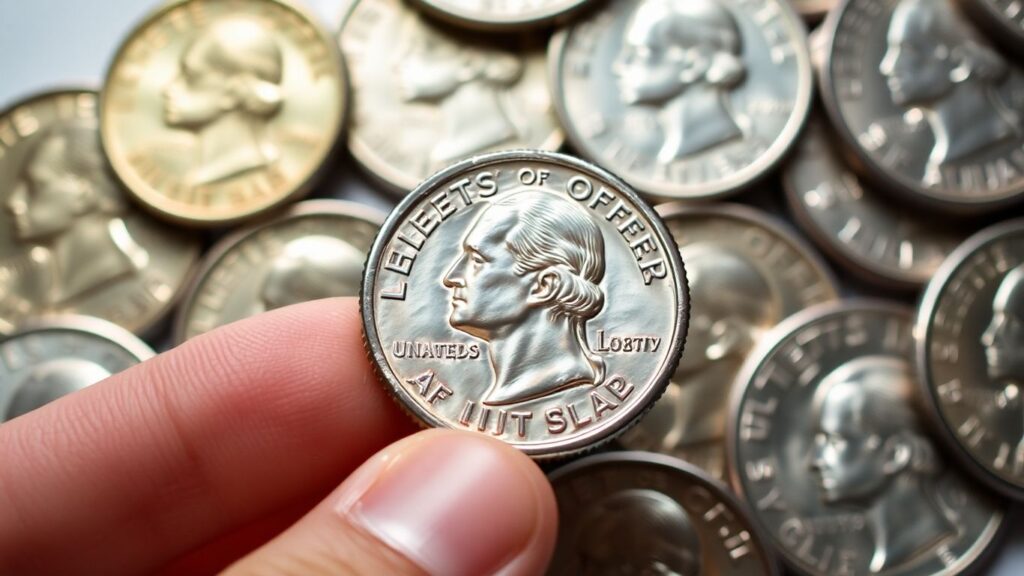
You know, sometimes you look at the change in your pocket and just see, well, change. But what if I told you some of those ordinary quarters could actually be worth a pretty penny? It sounds wild, but it’s true. We’re talking about finding the most valuable quarters you might have in your pocket right now, and it’s not as complicated as you might think. So, next time you get change, maybe give it a second look. You never know what hidden treasure you might be holding onto.
Key Takeaways
- Pay attention to the date and mint mark on your quarters. Older dates, especially before 1965, and those from less common mints like San Francisco (‘S’) or West Point (‘W’) can be more significant.
- Look for specific rare dates and low mintage issues. Coins like the 1916-D Standing Liberty Quarter or certain Washington Quarters from 1932 are historically significant and collectible.
- Errors during the minting process can create valuable coins. Things like doubled dies, strike-throughs, or even extra design elements (like the Wisconsin ‘Extra Leaf’ quarter) are sought after by collectors.
- Modern quarters, even those made after silver was removed, can have value. Special issues, like the ‘W’ mint mark quarters from West Point, or commemorative coins with unique features, are examples.
- The condition of a quarter matters a lot. Coins that are in mint state (like new) or have rare errors are generally worth more than worn ones. Knowing when to get a coin professionally graded can help determine its true worth.
Understanding What Makes A Quarter Valuable
So, you’ve got a handful of quarters, and you’re wondering if any of them are worth more than just 25 cents. It’s a fair question! Not all quarters are created equal, and a few key things can turn a common coin into a pocket treasure. Let’s break down what collectors look for.
The Significance of Date and Mint Mark
The date on a quarter tells you when it was made, and the mint mark shows where it was produced. These two pieces of information are super important. For instance, quarters made a long time ago, say before 1930, are often more interesting to collectors just because they’re older and have seen more history. The mint mark is usually a small letter, like ‘D’ for Denver, ‘S’ for San Francisco, or sometimes even ‘W’ for West Point. A coin’s rarity can be heavily influenced by how many were made at a specific mint in a specific year. For example, the 1916-D Standing Liberty quarter is incredibly rare because only a tiny number were ever produced.
The Role of Metal Composition
While most quarters you find today are made of a copper-nickel blend, older quarters and special issues can have different metal compositions. For a long time, quarters were made with a silver alloy. These silver quarters, especially those in good condition, are generally worth more than their face value simply because of the silver content. The U.S. Mint has also produced special quarters with different finishes or compositions for collectors, and these can sometimes carry a premium.
Identifying Key Dates and Low Mintage Issues
Some years and mint marks are just harder to find than others. These are often called
Discovering Rare Vintage Quarters
So, you’ve got some old quarters lying around? That’s pretty cool. Sometimes, these older coins, especially those made of silver, can be worth a surprising amount. It’s not just about the date, though that’s a big part of it. The condition of the coin and where it was made, its mint mark, play huge roles too.
The Elusive 1916-D Standing Liberty Quarter
If you’re talking about truly rare vintage quarters, the 1916-D Standing Liberty Quarter is the one that collectors dream about. Why? Because only 52,000 of them were ever made. That’s the lowest mintage for any U.S. quarter, ever. Finding one in good shape is like finding a needle in a haystack, and if you do, it could be worth a small fortune, potentially thousands of dollars. It’s a real gem for anyone serious about coin collecting.
Key Dates in the Washington Quarter Series
The Washington Quarter series, which started in 1932, has its own set of stars. The very first year, 1932, is a big deal. Both the Denver (‘D’) and San Francisco (‘S’) mints produced fewer than 500,000 quarters each that year. These low mintages, combined with the fact that it was the debut year for this iconic design, make the 1932-D and 1932-S quarters highly sought after. Even quarters from other years can be valuable if they have a low mintage or are in really nice condition. Checking the date and mint mark is your first step to see if you’ve stumbled upon a key date.
Here’s a quick look at some Washington Quarters to keep an eye out for:
- 1932-D: Low mintage, first year of issue.
- 1932-S: Also a low mintage, first year of issue.
- 1938-D: Another low mintage date in the series.
- 1950-D: While not as rare as the 1932 issues, it’s still a significant date for collectors.
The Intrigue of the 1950-D/S Overmint Error
Now, this one’s a bit quirky. Imagine a quarter where the mint mark looks a little… off. The 1950-D/S overmint error is a fascinating example of a minting mistake that collectors love. What happened was that an ‘S’ mint mark from San Francisco was somehow stamped over a ‘D’ mint mark from Denver. These kinds of errors weren’t supposed to happen, and because they’re so unusual and scarce, they can fetch a pretty penny. It’s a unique piece of minting history that adds a bit of mystery to any collection. Finding these kinds of errors can really boost the value of your collection.
Sometimes, the most interesting coins are the ones that weren’t quite made right. These little mistakes, or errors, are often what make a coin rare and desirable to collectors. It’s like finding a typo in a book that makes a rare edition even more special.
Exploring Modern Quarters With Hidden Value
It’s easy to think that all the really valuable quarters are old, maybe from before 1965 when they were made of silver. But honestly, that’s not always the case. You might be surprised what kind of change you can find in your pocket that’s worth more than just a quarter. The U.S. Mint has been busy, and some of their newer issues have turned out to be quite collectible.
The West Point Mint's 'W' Mint Mark Quarters
For a while now, the U.S. Mint has been releasing special quarters with a ‘W’ mint mark, indicating they were struck at the West Point Mint. These aren’t super common in everyday change, making them a bit of a treasure hunt. The 2019-W and 2020-W quarters, in particular, were produced in very limited numbers. Finding one of these in good condition can be a nice little find. For example, the 2019-W San Antonio Missions quarter has fetched some pretty high prices.
Special Commemorative Issues and Privy Marks
Beyond the ‘W’ mint marks, keep an eye out for special designs and markings. The America the Beautiful Quarters program, for instance, featured unique designs for each state and national park. While most are common, some specific issues or those with errors can be worth more. Also, look for things like privy marks – small secondary marks on the coin that signify a special event or location. The 2020 quarters celebrating the end of World War II had a privy mark with a WWII Memorial pool and a ’75’ inscription, and some of these were also made at West Point. These special editions are often made in silver proof versions too, which adds to their appeal.
The Appeal of Ultra-Low Mintage Modern Coins
What really drives up the value of modern coins? Often, it’s how many were made. The fewer there are, the more people want them, especially if they’re in great shape. Think about it: if only a few thousand of a certain quarter were ever produced, and most of those got spent and worn out, finding a crisp, uncirculated one becomes a big deal. This is why even quarters from the 2000s can sometimes be worth a good amount. It’s not just about the date; it’s about the rarity. You can find lists online detailing which modern quarters have the lowest mintages, which can be a good starting point for your search. Remember, even common dates can be valuable if they are in perfect condition, like an MS69 specimen.
The idea that only old coins hold value is a myth. Modern minting practices, special programs, and even simple mistakes can create coins that are surprisingly sought after by collectors. It pays to look closely at the change you receive.
Here’s a quick rundown of what to look for:
- ‘W’ Mint Mark: Quarters from West Point are generally scarcer.
- Special Privy Marks: Look for unique symbols or dates added to commemorate events.
- Low Mintage Numbers: The fewer coins produced, the higher the potential value.
- Proof and Silver Versions: Coins specifically made for collectors, often in silver, tend to be more valuable.
- Errors: Any oddities in the minting process can make a coin stand out. For instance, the 2004-D Wisconsin quarter with an ‘extra leaf’ is a well-known example of a valuable error coin. You can find more about these types of rare state quarters online.
Identifying Valuable Mint Marks
So, you’ve got a quarter in your hand. What’s next? After checking the date, the next big clue to a quarter’s potential worth is its mint mark. Think of it as a tiny signature from the place where the coin was actually made. Most quarters you’ll find today come from either Philadelphia (no mark or a ‘P’) or Denver (a ‘D’). These are the workhorses of the minting world, so while they can be valuable if they’re a special date or have an error, the mark itself usually doesn’t scream ‘rare’.
The Significance of the 'S' Mint Mark
Quarters with an ‘S’ mint mark mean they were produced at the San Francisco Mint. Now, this is where things start getting more interesting. While San Francisco has produced a lot of coins over the years, many of the ‘S’ marked quarters you’ll encounter are proof coins. These aren’t meant for everyday spending; they’re made with extra care, often having a mirror-like finish and sharp details. Because they’re made for collectors, they tend to be in better condition and can fetch higher prices, especially if they’re from a year with lower production numbers.
The Rarity of the 'W' Mint Mark
This is the one you really want to look for. The ‘W’ mint mark stands for the West Point Mint. For a long time, West Point didn’t put its mark on circulating coins, but they started doing so more recently, particularly with special issues. For example, in 2019, they released quarters with the ‘W’ mint mark as part of the America the Beautiful Quarters program. Only a small number of these were made – just 2 million of each design. That’s incredibly low compared to the hundreds of millions made at other mints. Finding a ‘W’ quarter is like finding a needle in a haystack, and collectors are willing to pay a pretty penny for them.
Understanding Denver and Philadelphia Marks
As mentioned, the ‘D’ for Denver and the ‘P’ (or no mark) for Philadelphia are the most common. Don’t just dismiss them, though. A Denver quarter from a key date, like a 1916-D (though that’s a Standing Liberty, not a Washington), or a Philadelphia quarter with a known error, can still be quite valuable. It’s just that the mint mark itself isn’t the primary driver of rarity in these cases. The date, condition, and any minting mistakes take center stage.
Here’s a quick rundown:
- ‘P’ (Philadelphia) or No Mint Mark: Most common, value usually tied to date/errors.
- ‘D’ (Denver): Also very common, similar to Philadelphia regarding value drivers.
- ‘S’ (San Francisco): Often proof coins, generally higher value due to collector focus and quality.
- ‘W’ (West Point): Very rare on circulating coins, highly sought after by collectors.
Remember, a mint mark is just one piece of the puzzle. A common mint mark on a rare date or a coin with a significant error can still be a jackpot. Always look at the whole picture: date, condition, and any unusual features.
The World of Quarter Minting Errors
Sometimes, coins come off the minting press with a little something extra – or missing. These aren’t just everyday wear and tear; these are actual mistakes made during the coin’s creation. Think of it like a typo in a book, but on a piece of metal. These minting errors can turn an ordinary quarter into something quite special for collectors.
Strike-Through Errors and Their Impact
A strike-through error happens when something interferes with the coin press while it’s striking the planchet (that’s the blank metal disc before it becomes a coin). This could be a piece of metal, a foreign object, or even just a bit of grease. Whatever it is, it gets pressed into the coin’s surface, leaving a mark. The value here really depends on what caused the strike-through and how clear the impression is. A simple grease mark might not add much, but a foreign object leaving a distinct shape? That could be a different story.
Recognizing Doubled Die Varieties
This is a pretty cool one. A doubled die error occurs when the die (the metal stamp that impresses the design onto the coin) is not perfectly aligned when it strikes the planchet, or if it’s struck twice with slight movement in between. This results in a ghost-like image or a doubling of the design elements. You might see doubled lettering, numbers, or even parts of the main design. The clearer and more pronounced the doubling, the more sought after the coin. It takes a good eye and often magnification to spot these, but they can significantly increase a quarter’s worth.
The Collectibility of Overstruck Coins
An overstruck coin is essentially a coin that has been struck more than once, often on a planchet that was already a coin. This can happen for various reasons, sometimes even involving foreign coins or tokens. A really interesting example is a 1983-P quarter that was struck over an amusement token. Imagine a coin meant for circulation being stamped on top of something that says "FOR PLAY ONLY / NO CASH VALUE." It’s a bit of a numismatic joke, and these kinds of unique errors are often highly prized. Finding these rare errors on state quarters can be a real jackpot for collectors. error coins
Here’s a quick rundown of what to look for:
- Off-center strikes: The design is not fully centered on the coin.
- Die cracks: A visible crack in the die can leave a raised line on the coin.
- Wrong planchet: The coin is struck on a metal disc intended for a different type of coin.
- Strikethroughs: Foreign material is pressed into the coin’s surface during striking.
When you’re hunting for these errors, remember to use good lighting and a magnifying glass. You’re looking for mistakes from the minting process itself, not damage that happened after the coin left the mint. Things like corrosion or scratches from circulation don’t usually add value in the same way a mint error does.
The State Quarter Program's Valuable Finds
So, the U.S. Mint ran this big program from 1999 to 2008, putting out quarters for each state. Billions of these things were made, so most of them are just worth, well, a quarter. But, like with anything, there are exceptions. Some of these state quarters have little quirks or errors that make them way more interesting to collectors, and yes, worth more than face value.
The Wisconsin 'Extra Leaf' Variety
This is probably the most famous one from the State Quarter Program. For the 2004 Wisconsin quarter, there were actually two different versions made. One has a normal leaf on the corn stalk, and the other has an extra leaf. It sounds minor, right? But it’s thought that only a small number of these ‘extra leaf’ ones were actually put into circulation. Because they’re so hard to find, collectors are willing to pay a pretty penny for them. We’re talking maybe $50 to $65 for a nice one, sometimes more if it’s in really good shape.
Minnesota's Doubled Die Discoveries
Another state that had a bit of a minting hiccup was Minnesota. For the 2005 Minnesota quarter, some coins were struck with a doubled die. This means that when the die that strikes the coin was made, it got a bit of a double image. You can often see this on the lettering or the design elements. While not as rare as the Wisconsin ‘extra leaf’, these doubled die Minnesota quarters can still fetch a decent price, maybe $5 to $100 depending on how clear the doubling is and the coin’s condition.
Silver Proof State Quarters
Okay, so this isn’t exactly an error, but it’s a way some state quarters can be worth more. The U.S. Mint also made special versions of these quarters called ‘proofs’. These were made for collectors and often came in sets. The really interesting ones are the silver proof versions, usually marked with an ‘S’ for San Francisco. These aren’t made of the regular copper-nickel clad; they’re made of 90% silver. Because of the silver content alone, these proofs are worth more than face value, usually around $30 to $35 each, and sometimes more if they’re in perfect condition.
The Mysterious 1976-S Silver Bicentennial Quarter
An Unexplained Minting Anomaly
Okay, so this one’s a bit of a head-scratcher. We’re talking about the 1976-S Silver Bicentennial Quarter. Officially, these were made to celebrate America’s 200th birthday, and they were supposed to be collector items, mostly in proof sets. But here’s the weird part: a small number of these 40% silver quarters, the kind that were meant for circulation (business strikes), somehow got out. And nobody’s exactly sure how or why. It’s like finding a unicorn in your change.
The Appeal of the Drummer Boy Design
Beyond the mystery, the design itself is pretty cool. Instead of the usual eagle, these quarters feature a colonial drummer boy on the reverse. It’s a really striking image, meant to evoke the spirit of 1776. It’s a departure from the standard designs, and that makes it stand out. Plus, knowing it’s made of 40% silver adds a bit of heft and intrinsic worth, even before you consider its rarity.
High-Value Specimens in Mint State
Now, about finding these things and what they’re worth. Most of the 1976-S silver quarters you might find are likely in proof sets, and those have a certain value. But the real prize, the ones that get collectors really excited, are the business strike versions that weren’t supposed to exist. Finding one of these in top condition, like a Mint State 69 (which is basically perfect), is incredibly rare. We’re talking about a coin that could sell for thousands of dollars at auction. It’s not just about the silver; it’s about the story, the rarity, and that perfect condition.
Here’s a quick look at what makes them special:
- Silver Content: Made with 40% silver, giving them more intrinsic value than regular clad coins.
- Uncertain Origin: Business strike versions were not officially released, adding a layer of mystery.
- Distinctive Design: The drummer boy motif is unique to the Bicentennial celebration.
- Rarity in High Grade: Finding these in perfect, uncirculated condition is exceptionally difficult.
The whole situation with these 1976-S silver quarters is a numismatic puzzle. Were they test coins? Souvenirs? A production glitch? The lack of a clear answer only adds to their allure for collectors who appreciate a good story behind their coins.
Grading Your Potential Treasures
So, you’ve gone through your change, maybe even bought a few rolls, and you think you’ve found something special. That’s awesome! But how do you know if it’s really worth something? This is where grading comes in. It sounds fancy, but it’s mostly about looking closely at your coin and comparing it to established standards. The better the condition, the higher the potential value, especially for rare finds.
Assessing Condition with Magnification
First off, you’re going to need a little help seeing the details. A simple magnifying glass, maybe 5x or 10x, is a good start. You’re looking for a few key things:
- Wear: Is the coin shiny and new-looking, or does it look like it’s been passed around a lot? Check the high points – the tops of Washington’s head, the eagle’s wings. If the details are worn smooth, it’s seen a lot of action.
- Luster: This is the "shine" or "glow" of an uncirculated coin. Does it have that original mint brilliance, or is it dull and lifeless?
- Marks and Scratches: Even uncirculated coins can have tiny nicks, bag marks, or scratches. The fewer and less noticeable these are, the better.
- Strike: How well-defined are the coin’s details? Sometimes, coins come off the press with weak details, making them less appealing.
Comparing Against Grading Standards
Once you’ve looked closely, you need to figure out where your coin fits. Coin grading uses a scale, most commonly the Sheldon scale, which goes from 1 to 70. For most of us looking at pocket change, we’re usually dealing with coins in the "circulated" range (meaning they’ve been used) or maybe "uncirculated" if you’re lucky.
Here’s a simplified look at some common grades:
| Grade Category | Description |
|---|---|
| Circulated | |
| Good (G-4) | Very worn, but major design elements are visible. |
| Fine (F-12) | Moderate wear, all lettering and design elements are clear. |
| Very Fine (VF-30) | Light wear on the high points of the design. |
| Extremely Fine (XF-45) | Slight wear, but most details are sharp. |
| About Uncirculated (AU-58) | Very light wear, almost looks uncirculated but has a trace of wear. |
| Uncirculated | |
| Mint State (MS-60+) | No wear, but may have bag marks or other imperfections. |
| MS-65 (Choice BU) | No wear, attractive luster, and only a few minor marks. |
| MS-70 (Perfect) | Absolutely flawless, perfect strike, and full luster. Extremely rare. |
Most coins you find in everyday change will likely fall somewhere between Fine and About Uncirculated. If you find one that looks like it just came from the mint, with full shine and no wear, you’re looking at the Mint State (MS) grades.
When you’re grading, try to be honest with yourself. It’s easy to get excited about a coin you found and want to give it a high grade. But comparing it side-by-side with photos online or in grading guides will help you be more objective. Remember, even a small difference in grade can mean a big difference in value for rare coins.
When to Seek Professional Grading
So, you’ve examined your coin, compared it to the standards, and you think you might have a real gem – maybe a rare error or a super-low mintage coin in amazing condition. That’s when it might be time to consider professional grading. Services like PCGS (Professional Coin Grading Service) or NGC (Numismatic Guaranty Company) have experts who will examine your coin and encapsulate it in a protective holder with its official grade. This adds a layer of authenticity and can significantly increase a coin’s marketability and value, especially for coins worth several hundred dollars or more. For common quarters, even in nice condition, professional grading usually isn’t worth the cost. It’s really for those potentially high-value finds.
Where to Sell Your Valuable Quarters
So, you’ve gone through your change, maybe with a magnifying glass and a bit of hope, and you think you’ve found a quarter that’s worth more than 25 cents. That’s exciting! But now comes the big question: where do you actually sell it? It’s not like you can just pop down to the corner store and trade it for a candy bar. You’ve got a few different paths you can take, and each one has its own pros and cons.
Leveraging Auction Houses for High-Value Coins
If you’ve got something truly special, like a rare error coin or a key date in amazing condition, an auction house might be your best bet. These places are set up to handle valuable items and have a wide reach. They can get your coin in front of serious collectors from all over who might be willing to pay top dollar. It takes a bit longer, and they do take a cut of the sale price (usually around 15-20%), but for that really special piece, it can often get you the best return. Think of it as giving your coin its own spotlight.
Engaging with Local Coin Dealers
For a quicker sale, or if you have a few different coins you want to get rid of at once, a local coin dealer is a solid option. They know the market and can often give you a price on the spot. It’s convenient, and you get cash right away. Just be aware that dealers need to make a profit too, so they’ll likely offer you a price that’s a bit lower than what you might get selling directly to a collector. It’s a trade-off for speed and ease. You can often find reputable dealers through coin collecting clubs or by checking out established coin shops.
Connecting with Collectors at Coin Shows
Coin shows are a whole different ballgame. They’re like a big party for coin enthusiasts. You can set up a table, meet collectors face-to-face, and sell your coins directly. This cuts out the middleman, and you might get a better price. Plus, you get to talk to people who are just as excited about coins as you are. It’s a great way to learn more and build connections in the hobby. You’ll need to factor in travel costs and the time it takes to set up, but it can be a really rewarding experience.
Here’s a quick look at how these options stack up:
| Selling Venue | Best For | Typical Returns (of market value) | Pros | Cons |
|---|---|---|---|---|
| Auction Houses | High-value, certified coins | 90-110% of estimate | Expert marketing, global reach | Consignment time, high fees |
| Local Coin Dealers | Quick sales, bulk lots | 60-80% of retail | Immediate payment, no shipping | Lower prices, limited variety knowledge |
| Coin Shows | Networking, bulk deals | 70-90% of retail | Multiple buyers, cash deals | Travel costs, limited schedule |
| Online Marketplaces | Individual coins, patient sellers | 85-95% of market | Direct to collector, competitive prices | Fees, shipping risks, returns |
Before you head out to sell, make sure you’ve got a good idea of what your coin is worth. Knowing its grade and rarity will help you get a fair price. Don’t clean your coins, ever! That almost always ruins their value. Handle them by the edges, too.
Ultimately, the best place to sell depends on your coin and what you want out of the sale. Do your homework, know your coin’s condition, and choose the path that feels right for you.
So, What's the Takeaway?
It turns out that those little 25-cent pieces jingling in your pocket might be worth more than you think. We’ve seen how everything from old silver coins to modern ones with tiny mistakes or special mint marks can fetch a pretty penny. So next time you get change, maybe take a second look. You never know, you might just find a hidden treasure hiding in plain sight. It’s kind of like a mini treasure hunt, but the prize is already in your hand. Happy hunting!
Frequently Asked Questions
What makes a regular quarter more valuable than its face value?
Several things can make a quarter worth more than 25 cents. Older quarters, especially those made before 1965, are often made of silver and are more valuable. Also, coins with special mint marks, rare dates, or mistakes made during the minting process can be worth a lot more money to collectors.
Are quarters made after 1964 still valuable?
Yes, absolutely! While most quarters made after 1964 are not silver, some can still be very valuable. Special issues like those from the West Point Mint (marked with a ‘W’), certain commemorative coins, or those with minting errors can fetch high prices.
What is a mint mark and why is it important?
A mint mark is a small letter on a coin that shows where it was made. Common marks are ‘P’ for Philadelphia and ‘D’ for Denver. Less common marks like ‘S’ for San Francisco or ‘W’ for West Point can indicate a rarer coin, especially ‘W’ mint marks which were produced in very small numbers.
What are some examples of valuable errors on quarters?
Errors can happen during minting and make coins valuable. Some common errors include ‘double dies,’ where a design looks like it was stamped twice, or ‘strike-throughs,’ where something like grease or debris got on the coin while it was being made, leaving a mark. Even small mistakes can make a quarter a treasure!
Are State Quarters worth anything special?
Most State Quarters are only worth their face value, but some have special errors that make them collectible. For example, the Wisconsin quarter with an ‘extra leaf’ or Minnesota quarters with doubled lettering are sought after. Also, silver proof versions of State Quarters are worth more.
What's special about the 1976-S Silver Bicentennial Quarter?
The 1976-S Silver Bicentennial Quarter is interesting because it was made with silver and has a unique drummer boy design. While most were proof coins for collectors, a small number of silver ones made it out, and finding them in perfect condition makes them quite rare and valuable.
How do I know if my quarter is valuable enough to get graded?
You can start by looking closely at the date, mint mark, and for any obvious errors or unusual wear. Comparing your coin to pictures and descriptions online can give you an idea. For quarters that seem particularly old, rare, or have clear mistakes, getting them professionally graded is a good idea to confirm their value.
Where should I go if I think I have a valuable quarter to sell?
If you believe you have a valuable quarter, you have a few options. For very rare and high-value coins, auction houses can be a good choice. Local coin dealers can offer quick sales and expert opinions. Attending coin shows allows you to meet collectors directly and potentially get better prices.